
This Week
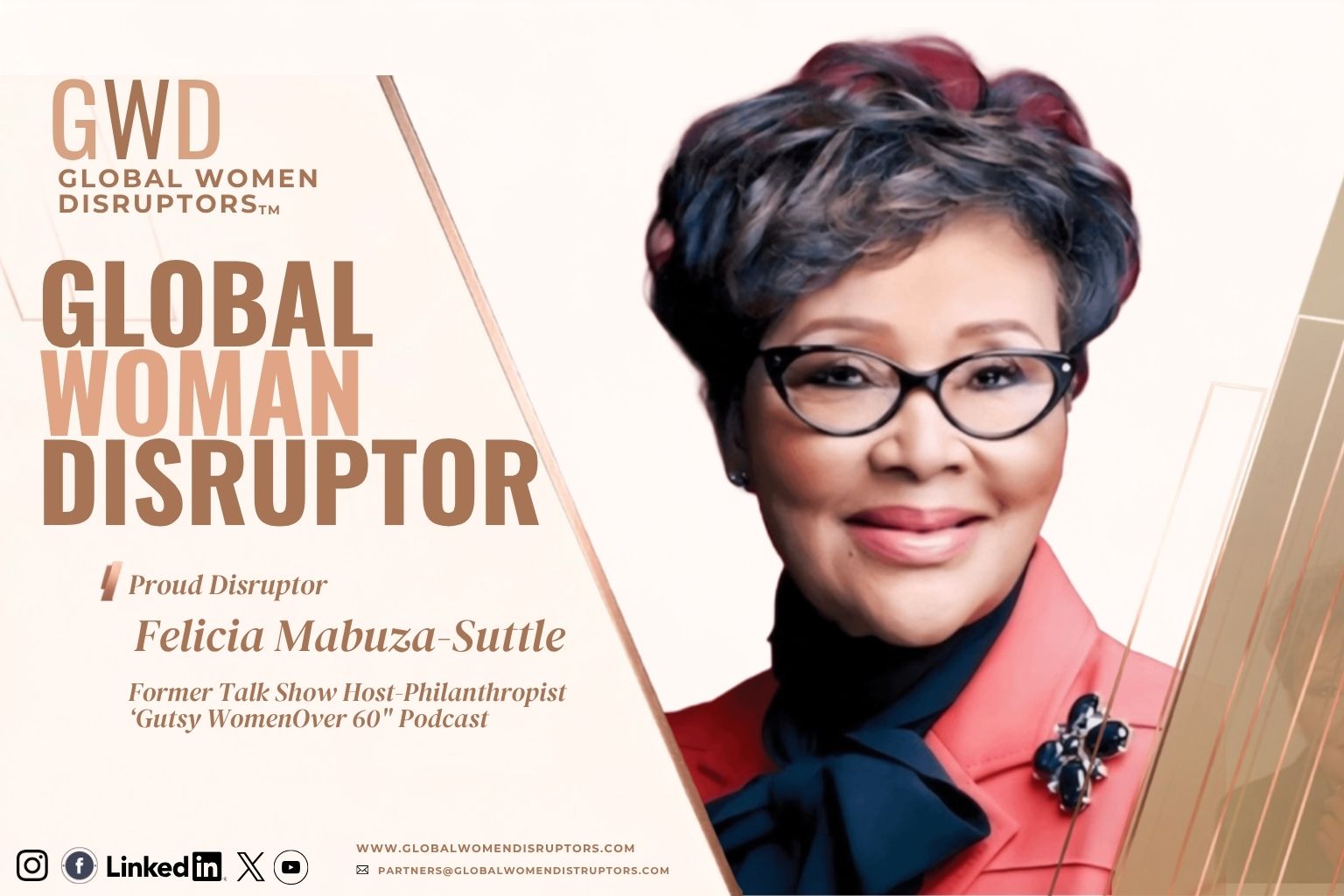
FELICIA MABUZA-SUTTLE
Former Talk Show Host · Philanthropist
‘Gutsy Women Over 60” Podcast
South Africa
Her Story
Felicia Mabuza-Suttle
Felicia Mabuza-Suttle is a South African talk show hostess, entrepreneur, author, columnist, and public speaker — and one of the most widely recognized women in southern Africa's media and business history.
She was born on June 3, 1950, in Sophiatown, a Black neighborhood in Johannesburg, during the apartheid era, when every facet of daily life was racially segregated. Raised largely by her grandfather, Ben Mabuza — a self-made businessman who owned and operated a butchery and restaurant near downtown Johannesburg — she credits him as the driving force behind her later success. Her father, who owned one of the country's first driving schools, provided steady support for the family, and her childhood in Sophiatown and later Soweto immersed her in music, dance, and community. She grew up in a household full of musicians — her father played saxophone, one uncle played piano, and another was a renowned drummer married to the singer Busi Mhlongo — and both of her grandmothers sang in the church choir. As the youngest member of Emily Motsieloa's singing group, the Tiny Tots, she performed in white dresses, red ribbons, and black shoes, and counts opening for Miriam Makeba and the Manhattan Brothers among her fondest memories. To this day, she sings and dances to nearly every genre — jazz, mbaqanga, kwaito, R&B, amapiano, and hymns among them.
In the 1960s and 70s, as apartheid tightened its grip, many young Black South Africans went abroad to study. Mabuza-Suttle was among them, enrolling at Marquette University in the United States, where she earned a BA in Journalism followed by an MA in Mass Communication — becoming the first member of her family to earn a college degree — an experience she later honored by establishing a scholarship for South African students at Marquette. While studying, she wrote for The World newspaper, where she crossed paths with prominent anti-apartheid activists, including Steve Biko. It was in the United States, working alongside the American civil rights movement, that she found her own political voice, advocating for sanctions against the apartheid regime. It was also there that she met and married Dr. Earl Suttle, a school psychologist, with whom she raised two daughters, Lindiwe and Zanele.
In 1992, Mabuza-Suttle was offered a role as a talk show host at the South African Broadcasting Corporation. The show — first called Top Level, later The Felicia Show, and eventually simply Felicia — became a defining platform of 1990s South African television, tackling social issues alongside moments of celebration and joy as the country navigated its transition out of apartheid.
Her leadership has extended well beyond broadcasting into corporate and civic service. Mabuza-Suttle served as Vice President of Communications at South African Airways, leading the airline's communications transformation as the country navigated its passage from apartheid to democracy. She went on to serve as President of South African Tourism in the United States, working to encourage more Americans to travel to South Africa — a mission reflected today in the large numbers of American travelers who now visit the country each year.
Beyond broadcasting, she has built a diverse portfolio of ventures, including the Felicia apparel and accessory line, Pamodzi Investments, FMS Productions, and the restaurant Back of the Moon, while directing a portion of proceeds from her eyewear line toward drug and crime prevention initiatives. She has also taught at a top finishing school and regularly conducts seminars on image and confidence — practicing, as she puts it, what she preaches. Her work has earned her numerous honors, including the Progress (Impumelelo) Top 300 Empowerment Award in 2004 and recognition as one of the Leading Women Entrepreneurs of the World in 2001. In a public poll on the television special Great South Africans, she was voted the 70th greatest South African of all time.
In Her Corner
Her story is still being written — and the championship rounds are still ahead of her.